Introduction and Motivation
Objectives
Know what to expect from this course
Build a general, programming-language agnostic notion of performance
Instructor note
Inform the format of this talk
Mix of talk, type-along and demos
5 min teaching
Python and its defacto implementation CPython is now widely used for a spectrum of applications. It has now experienced practitioners doing web-development, analytics, research and data science. This is possible because of the following traits of the Python ecosystem:
Batteries included
High-level programming that abstracts away the technical details
Mature well-maintained libraries which form a firm foundation, the scientific Python ecosystem, which includes:
and many more…
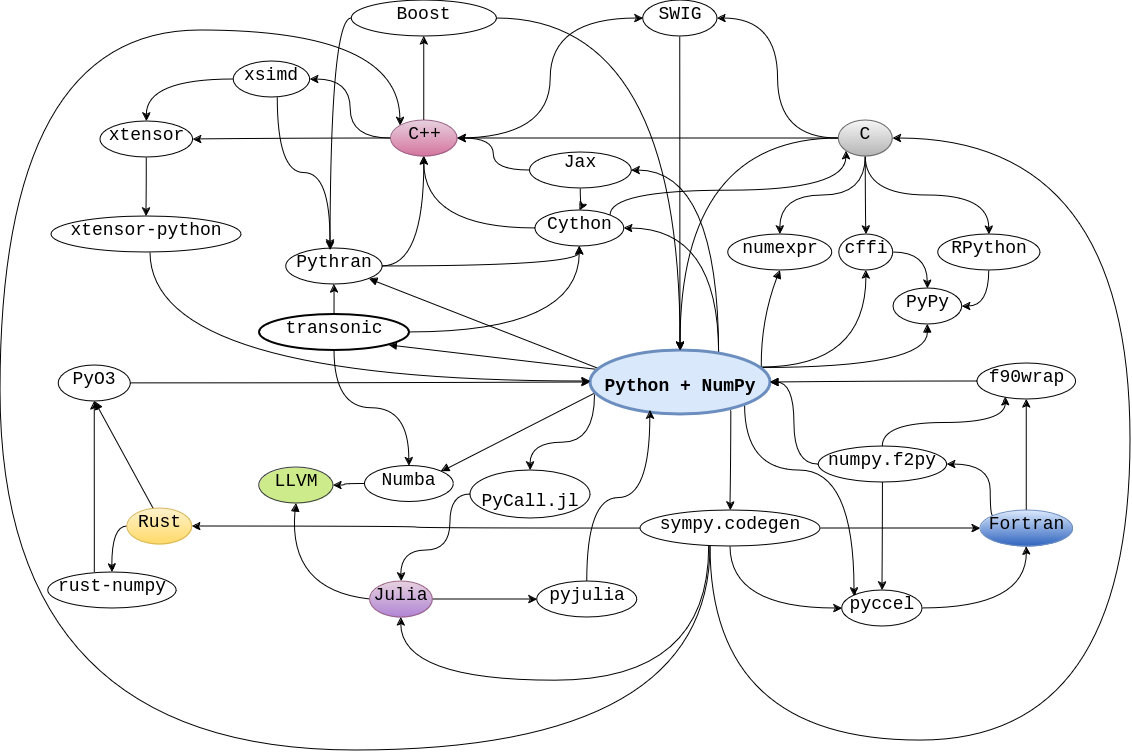
Different kinds of performance bottlenecks
I/O bound: the code idles often and is waiting for a disk or network read/write operation to finish. Such bottlenecks can be often remedied by caching, multi-threading or async-programming.
Memory bound: the data to be processed does not fit in the RAM and the code needs to process data in batches instead. This is often a hardware limitation.
CPU bound: the code consumes a lot of CPU cycles, often seen by monitoring the system showing 100% CPU usage in 1 core for serial applications, or in all cores for parallel applications. This will be the focus of this course.
Gems of wisdom
Before we dive further into the course it is important to remember some idioms, which is true in the case of most real-world applications.
Keypoints
Find a balance between runtime efficency and cost of development.
Tests can help in maintain correctness before you change the code.
CPU-bound or I/O-bound or memory bound?
Do not optimize everything.
Creating extensions are one way of improving performance